5 Factors That Drive Assisted Living Cost: What Each One Means for Your Family
Read on to understand the five key factors that shape assisted living costs and how each one affects what your family will actually pay.
Assisted living communities offer a supportive environment for older adults who need help with daily activities but don't require the round-the-clock medical care of a nursing home. While the benefits are clear, the cost picture is less so. Assisted living cost isn't a single number. It varies significantly by geography, care level, and the services included. Five factors account for most of that variation.
Understanding what drives the price helps families plan more accurately, ask better questions during tours, and compare options without being surprised after a move-in.
1. Housing and Accommodations
One of the largest cost variables in assisted living is the living space itself. Communities typically offer private apartments, shared rooms, or studio apartments. The size, layout, and amenities of the unit affect the monthly rate significantly.
A private one-bedroom apartment in a well-appointed community typically costs more than a shared room in a comparable facility. Some communities also offer tiered pricing based on unit size and floor location. Families who are flexible on room type often find meaningful cost savings without giving up quality of care.
2. Meal Plans and Dining
Assisted living communities typically include meals in the monthly fee. The cost included for dining reflects the quality of the food, the variety of menu options, and whether dietary accommodations are available.
Some communities offer all-inclusive meal plans. Others allow residents to choose a tiered plan based on how many meals per day they want. For residents who prefer to cook occasionally or eat independently, this flexibility can reduce costs while maintaining access to dining services.
3. Healthcare Services and Care Level
The level of care a resident requires is one of the most significant drivers of assisted living cost. Basic care typically covers help with daily activities such as bathing, dressing, medication management, and mobility assistance. More intensive care, such as support for a resident who needs extensive daily assistance, memory care-level supervision, or management of multiple chronic conditions, costs more.
Most communities assess each resident individually and apply a care tier or point-based pricing system. Families should ask specifically how care level is assessed, how the pricing tier is structured, and how much a step up in care level would affect the monthly cost.
4. Location
Assisted living cost varies more by geography than almost any other factor. A private apartment in a community in rural Nebraska will cost significantly less than a comparable room in suburban San Francisco. State regulations, real estate costs, staffing costs, and local market competition all factor into regional pricing differences.
National median cost figures by state give a useful benchmark for what to expect in a given region. Senior Care Finder's post on Assisted Living Costs by State in the U.S. provides state-level data for planning purposes.
5. Lifestyle Amenities and Activities
Assisted living communities vary widely in the amenities and programs they offer. Fitness centers, pools, arts programs, cultural outings, transportation services, and concierge-level services add to the experience and to the monthly cost.
A community with a robust activity calendar, multiple dining venues, and resort-style amenities will typically charge more than a community with standard amenities and fewer programs. Families should weigh the importance of amenities relative to care quality, not assume that higher cost equals better care.
How Families Pay for Assisted Living
Assisted living costs are primarily a private-pay expense. There is no equivalent of Medicare's skilled nursing benefit for ongoing residential assisted living care. Families typically fund assisted living through a combination of the following:
Personal savings and retirement income: The most common funding source. Social Security income, retirement account distributions, pension payments, and investment income are often the core of a monthly payment plan.
Long-term care insurance: Policies purchased before significant health decline can cover a meaningful portion of assisted living costs, depending on the policy's daily benefit amount, elimination period, and inflation protection. Families should review the policy's specific terms carefully, as coverage varies significantly by plan.
Veterans' benefits: Qualifying veterans and their surviving spouses may be eligible for the Aid & Attendance benefit through the VA, which provides additional monthly pension income that can be applied toward assisted living costs. For more on eligibility and how to apply, see Assisted Living for Elderly Veterans.
Home equity and asset liquidation: Many families use proceeds from the sale of the family home to fund assisted living. Bridge loans, which provide short-term financing while a home sale is pending, are another option families use to cover costs during a transition.
Financial Challenges Families Should Plan For
The costs associated with assisted living can be significant, and planning ahead makes a meaningful difference. A few realities families encounter:
-
Assisted living costs can increase over time, both through annual rate adjustments and through care level changes as needs evolve
-
Move-in fees or community fees at some communities require an upfront payment, separate from the monthly rate
-
Running out of personal assets is a scenario families should discuss with a financial advisor before a move, not after
-
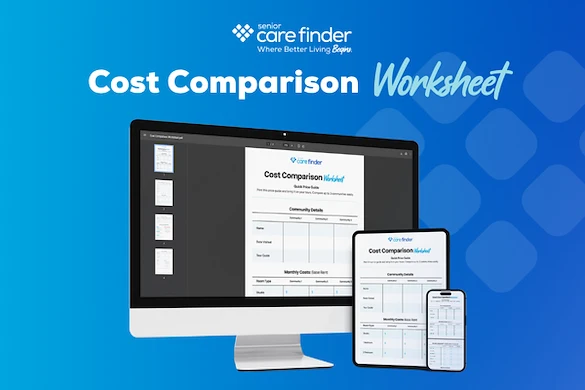
Comparing multiple communities with a cost-comparison worksheet helps families see the total monthly picture rather than just the base rate. The Cost Comparison Worksheet available from Senior Care Finder is a free resource for this.
The Emotional Side of the Cost Conversation
Beyond the financial considerations, the decision to move to assisted living carries real emotional weight for both seniors and their families. Talking about money often feels clinical when the conversation is really about a parent's future, independence, and dignity.
The cost conversation goes more smoothly when families frame it as a practical part of planning for care that matches the actual need, not as a question of what can be afforded grudgingly. Clear information helps. Honest conversation with the person moving helps more.
What to Do Next
Understanding the five factors that drive assisted living cost, accommodations, dining, care level, location, and amenities, puts families in a much better position to evaluate options accurately and ask the right questions during tours. The goal is a setting that matches the actual care need and financial situation, not one that overshoots or undershoots either.
Find Assisted Living Near You
Senior Care Finder offers a free, ungated national directory of assisted living communities. No referral fees. No sign-up required. Search, compare, and connect directly with providers.
Find Assisted Living Near You →